“`html
OpenAI has just reached a new milestone in AI-assisted education. Since March 10, 2026, ChatGPT offers interactive visuals for mathematics and science, allowing users to directly manipulate formulas, variables, and mathematical relationships in real time. A feature called dynamic visual explanations that could well transform how millions of students approach subjects known to be difficult. What topics are covered? How do you access them? And what are these new educational tools worth compared to the competition? This article provides an overview.
Dynamic visuals for understanding concepts in depth
Until now, ChatGPT answered mathematics and science questions primarily in text and static diagrams. With interactive visuals, OpenAI is radically changing its approach: the user no longer simply reads an explanation, but directly interacts with the concept.
The most striking example is the Pythagorean theorem: by adjusting the length of a triangle’s sides directly in the interface, you see the hypotenuse update instantly. Variables react in real time, making the mathematical relationship immediately intuitive.
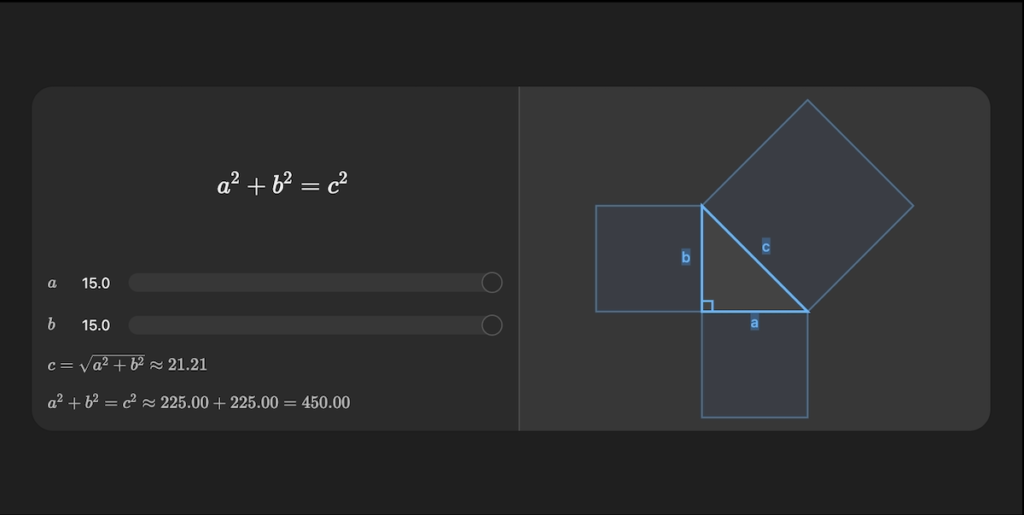
This pedagogical approach rests on a well-established principle in educational science: active learning promotes better retention and more lasting understanding than passive reading alone.
Over 70 topics available at launch
At its launch, the feature covers over 70 mathematical and scientific topics. Among the available topics are notably:
- Mathematics: linear equations, binomial square, difference of squares, exponential decay, compound interest, area of a circle
- Physics: Coulomb’s law, Hooke’s law, kinetic energy, Ohm’s law
- Chemistry: Charles’s law
To access interactive visuals, simply ask ChatGPT a direct question, for example: “What is the lens equation?” or “How do you calculate the area of a circle?” ChatGPT then automatically generates an interactive module alongside its textual explanation.
The feature is available to all users logged into ChatGPT, regardless of subscription plan. OpenAI also announced that the list of topics will be progressively expanded in the coming weeks.
A strategic turning point for OpenAI in education
The launch of these ChatGPT interactive visuals is not insignificant in the current context. According to OpenAI, over 140 million people use ChatGPT every week to get help with mathematics and science — two subjects that historically concentrate the greatest academic difficulties.
This new feature marks a significant shift in positioning: ChatGPT no longer merely provides answers; it invites the user to actively engage with underlying concepts. The tool becomes more of an interactive tutor than a simple answer engine.
This shift is part of a broader OpenAI strategy around education. The platform had already deployed study mode, which guides students step-by-step through problem-solving, as well as QuizGPT, which allows users to create study guides and be quizzed before exams.
A race for interactivity among AI giants
OpenAI is not alone in this arena. Last November, Google Gemini had already launched its own interactive diagrams and educational visuals, signaling that education has become a strategic battleground for major artificial intelligence platforms.
The question now is one of the real pedagogical depth of these tools. While the principle of interactive visuals is appealing, their effectiveness will depend largely on how they are integrated into learning practices. The debate remains lively in the educational community: while some teachers fear excessive AI dependency, many students and teachers have already adopted these tools in their daily routines.
Conclusion: pedagogical AI enters a new era
With its interactive visuals for mathematics and science, ChatGPT takes an important step in its transformation into a true pedagogical assistant. The approach — manipulating variables to see real-time effects — is consistent with active learning methods that have proven their worth. Available immediately to all logged-in users and covering over 70 topics, the feature arrives at the right time for a platform that claims 140 million weekly users seeking help with these subjects. OpenAI and Google are now in direct competition on the interactive education front — and ultimately it’s the learner who comes out ahead.
Source: TechCrunch
“`