
Choosing the right AI translation tool in 2026 has never been so strategic — nor so complex. The machine translation market will reach $3.3 billion by 2026, driven by growing global demand for multilingual communication and the emergence of large language models (LLMs) that have radically transformed translation quality.
- How AI revolutionized translation
- The 7 best AI translation tools in 2026
- 1. DeepL — The precision champion for European languages
- 2. Google Translate — The indispensable accessibility tool
- 3. ChatGPT — The best for creative and contextual translation
- 4. Microsoft Translator — The tool integrated into Microsoft 365
- 5. Reverso — The pedagogical and contextual translator
- 6. Claude (Anthropic) — The LLM alternative for long and complex texts
- 7. Weglot — Website translation specialist
- Comparison table of the best AI translation tools
- Which tool to choose based on your use case?
- For professional translations in European languages
- For daily free and versatile use
- For marketing, creative content, or transcreation
- For an enterprise in the Microsoft ecosystem
- For a multilingual website with SEO
- Key limitations to know before trusting AI for translation
- Conclusion
Ten years ago, submitting a contract to machine translation was a joke. Today, the best tools rival junior translators on many types of text, and professionals themselves — translators, lawyers, marketers, developers — use them as daily work tools. According to industry research, a professional translator leveraging AI is now five times more productive than a colleague working without it.
But all these tools are not equal. DeepL excels on European languages, Google Translate covers 249 languages and works on the go, ChatGPT handles creative nuances better than anyone. This detailed comparison helps you choose the tool suited to your use case, budget, and quality requirements.
How AI revolutionized translation
Before 2016 and the arrival of artificial neural networks in machine translation, tools relied on statistical rules that produced often mechanical and unnatural results. Neural machine translation (NMT) changed the game by allowing models to analyze the global context of a sentence rather than processing it word by word.
Since 2022, a second revolution has been underway with large language models (LLMs) like GPT and Claude: trained on billions of multilingual texts, they no longer merely translate — they understand the intention behind words, adapt register, manage idioms, and can even account for cultural specificities of a region.
Both approaches coexist on the market today: specialized engines (DeepL, Google Translate) optimized for precision and speed, and generalist LLMs (ChatGPT, Claude) that excel in contextual and creative translation. Understanding the difference between these two families of tools is essential for making the right choice.
The 7 best AI translation tools in 2026
1. DeepL — The precision champion for European languages
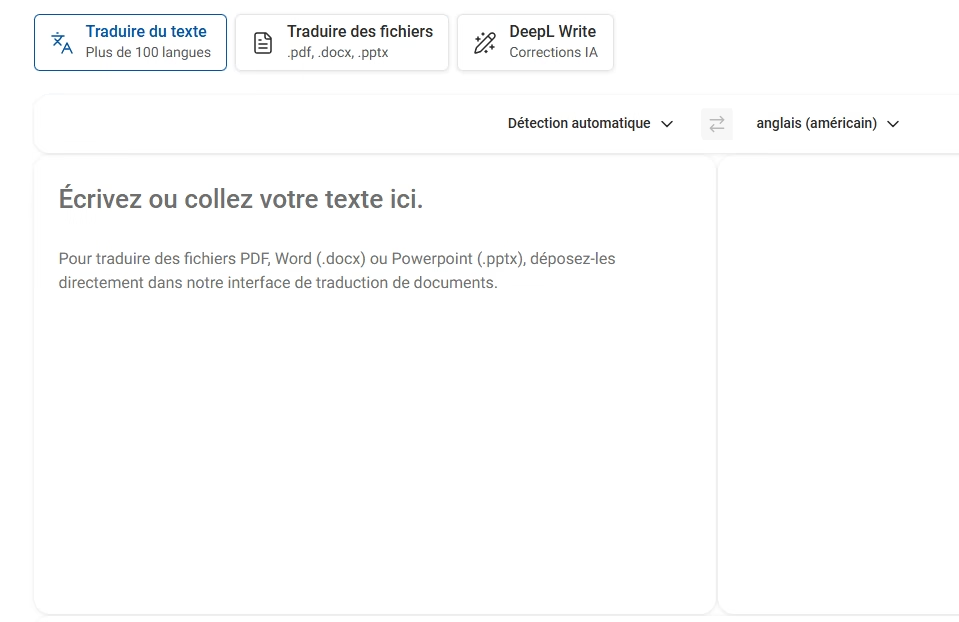
DeepL is the undisputed reference for high-quality professional translation on European languages. Founded in 2017 in Cologne, it relies on a custom-built LLM specialized exclusively in linguistics, trained on proprietary data selected by experts. This specialization makes the difference: while ChatGPT does everything, DeepL does translation better than anyone.
Its custom glossaries are a decisive feature for enterprises: Deutsche Bahn uses 30,000 glossary entries to maintain consistent terminology across 16 languages simultaneously. Translation of entire documents (Word, PowerPoint, PDF) while fully preserving original formatting saves hours of manual reformatting.
On the data security front, DeepL Pro offers a “zero data” policy: texts are neither stored nor used for model training — a decisive argument for legal, medical, or financial sectors. KBC Bank translates 70 million words per month via DeepL with this guarantee.
In 2026, DeepL now supports 81 languages (up from 33 in its early years) and has launched DeepL Voice, available in two modes: Voice for Meetings to subtitle Teams and Zoom meetings in real time, and Voice for Conversations for face-to-face exchanges via mobile app.
DeepL’s next-generation language model outperforms Google Translate, ChatGPT-4, and Microsoft in translation quality: its translations require twice fewer revisions than Google and three times fewer than ChatGPT-4 to achieve equivalent quality.
Strengths: surgical precision on European languages, glossaries, document translation with formatting, zero-storage data security, CAT tool integration.
Limitations: more limited language coverage than Google (81 languages vs. 249), high price in Pro version.
Pricing: free version (limited text, 3 documents/month); DeepL Pro from €8.99/month (Starter); Advanced and Ultimate plans for professional volumes.
Ideal for: legal, finance, and healthcare professionals, translators, agencies, international companies with terminology consistency needs.
2. Google Translate — The indispensable accessibility tool
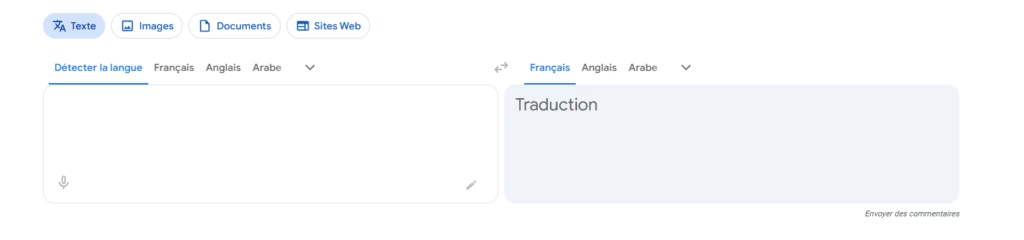
Google Translate remains the most widely used translation tool in the world with 500 million active users. Its main asset is unbeatable: 249 languages supported, including many low-resource languages and endangered languages that no other competitor covers.
For mobile translation, Google Translate is irreplaceable. The mobile app offers camera translation (point your phone at a menu, sign, document), offline translation (downloadable language packs), and real-time conversation translation in 70 languages — a valuable feature during international business travel.
In terms of pure quality, Google has significantly improved its engine in recent years thanks to its own Transformer architectures. On language pairs with large data volumes (English-French, English-Spanish, English-Mandarin…), results are very satisfactory for daily use. Shortcomings appear in idioms — often translated too literally — and in the naturalness of output compared to DeepL.
Strengths: 249 languages, completely free, camera translation, offline mode, Chrome and Google ecosystem integrations.
Limitations: lower quality than DeepL on European languages, translations sometimes too formal or literal, less suitable for demanding professional content.
Pricing: 100% free for web and mobile use; paid API for developers ($20/million characters).
Ideal for: daily use, travel, rare languages, general public users, quick translation without premium quality requirements.
3. ChatGPT — The best for creative and contextual translation
ChatGPT is not a translator in the classical sense — it’s a generalist LLM that translates with unmatched contextual intelligence. Its strength lies in its ability to understand the intention behind words: it doesn’t translate marketing text word for word, it adapts it culturally to the target audience. This is what’s called transcreation.
On conversational, creative, and marketing texts, ChatGPT produces remarkably natural results. Where DeepL tends to slightly formalize, ChatGPT preserves the tone and register of a casual email, social media post, or advertising hook. You can ask it to translate “in formal British English,” “in Mexican Spanish for an 18-25 target audience,” or even “while preserving wordplay from the original text” — nuances that specialized engines don’t handle.
The ChatGPT Translate tool, launched by OpenAI, is a dedicated translation interface that simplifies workflow compared to a standard chatbot query. It offers immediately available customization options without requiring complex prompts.
Its main limitation: as an LLM, ChatGPT can paraphrase or rephrase passages of the source text. For contracts, medical files, or any content where every word technically matters, this risk is real and human verification is necessary. It is also slower than DeepL or Google for large volumes.
Strengths: transcreation and cultural adaptation, handling nuances and idioms, tone and register customization, multimodality (also translates images with text).
Limitations: can rephrase source content, less precise on technical terminology, not suited for large volumes, slower.
Pricing: free version with limited access; ChatGPT Plus at €23/month for GPT-4 and priority access.
Ideal for: marketing, communication, creative texts, professional email translation, cultural adaptation, content requiring tone and style.
4. Microsoft Translator — The tool integrated into Microsoft 365
Microsoft Translator is the translation tool natively integrated into the entire Microsoft 365 suite: Word, PowerPoint, Excel, Teams, Outlook, and Edge. For enterprises whose teams already work in the Microsoft ecosystem, this is a decisive advantage — no need to switch tools or copy-paste between applications.
The service supports more than 130 languages and offers real-time multilingual conversation translation in Teams — particularly useful for international meetings. The Azure Translator API allows integration into custom business applications with advanced terminology customization options.
In terms of pure quality, Microsoft Translator ranks below DeepL on European language pairs, but its main asset remains its seamless integration into existing workflows.
Strengths: native Microsoft 365 integration, real-time translation in Teams, robust Azure API for developers.
Limitations: translation quality inferior to DeepL, less suited for creative content.
Pricing: included in Microsoft 365 subscriptions; Azure API from $10/million characters.
Ideal for: companies already in the Microsoft ecosystem, Teams meeting translation, integration in business applications.
5. Reverso — The pedagogical and contextual translator
Reverso offers an original approach: beyond simple translation, it presents translated words or expressions in their context, with sample sentences drawn from bilingual corpora. A valuable aid for avoiding meaning errors and understanding usage nuances.
The tool covers 26 languages and offers complementary features particularly useful: synonyms in the target language, pronunciation, conjugation, and — its specialty — a flashcard system to memorize new vocabulary. It’s both a translator and a language learning tool.
Reverso Context (web version) lets you search for a specific expression and immediately see how it’s used in thousands of professionally translated texts. For translators, it’s a valuable verification tool.
Strengths: contextual examples, learning aid, synonyms and pronunciation, free for basic use.
Limitations: limited language coverage (26 languages), no document translation, less suitable for large professional volumes.
Pricing: free version; Premium subscription from around €9.99/month.
Ideal for: language learners, translators verifying lexical choices, academic use, texts sensitive to nuances.
6. Claude (Anthropic) — The LLM alternative for long and complex texts
Claude, developed by Anthropic, is often presented as the most serious alternative to ChatGPT for creative and contextual translation. Its key advantage is its extended context window — up to 200,000 tokens in advanced versions — enabling it to translate very long documents while maintaining stylistic consistency across the entire text.
Where ChatGPT can lose track of register or narrative voice over long texts, Claude maintains remarkable consistency. It is particularly favored for translating novels, detailed reports, long technical documentation, and any content where stylistic homogeneity over large volumes is determining.
Like ChatGPT, it excels at transcreation and handling cultural nuances, but is unsuitable for ultra-precise technical translation without human review.
Strengths: very large context window, stylistic consistency on long documents, excellent for transcreation.
Limitations: no dedicated translation interface, less precise on specific technical terminology, slower than specialized engines.
Pricing: free version available; Claude Pro at €23/month; Enterprise versions by quote.
Ideal for: translation of long texts (novels, reports, documentation), creative adaptation, editorial content.
7. Weglot — Website translation specialist
Weglot is not a generalist translator — it’s a solution dedicated to website localization, and in this specific domain, no tool equals it. It integrates directly into your CMS (WordPress, Shopify, Wix, Webflow…), automatically detects all textual content on your site and generates a searchable translated version.
Its strength lies in the combination: it uses multiple AI engines in the background (DeepL, Google Translate, ChatGPT) to produce an initial machine translation, then allows human review directly in a dedicated interface. Each modification is remembered for future updates. Multilingual SEO is natively integrated: each language has a distinct URL, correct hreflang tags, and independent Google indexing.
Strengths: turnkey solution for websites, native multilingual SEO, combination of multiple AI engines, automatic update management.
Limitations: tool purely dedicated to websites, not usable for other types of translation.
Pricing: from €17/month (Starter plan, 1 language, 2,000 words); Business plans for large volumes.
Ideal for: e-commerce merchants, bloggers, SaaS, any company wanting SEO-optimized multilingual online presence.
Comparison table of the best AI translation tools
| Tool | No. languages | Free plan | Starting price | Main strength | Primary limitation |
|---|---|---|---|---|---|
| DeepL | 81 | ✅ Limited | €8.99/month | EU language precision | Language coverage |
| Google Translate | 249 | ✅ Full | Free | Maximum coverage | Quality on pro texts |
| ChatGPT | 100+ | ✅ Limited | €23/month | Context and nuances | Can rephrase |
| Microsoft Translator | 130+ | ✅ Via Azure | Included in M365 | Microsoft integration | Quality inferior to DeepL |
| Reverso | 26 | ✅ Basic | €9.99/month | Context and examples | Limited coverage |
| Claude | 100+ | ✅ Limited | €23/month | Long texts | No dedicated interface |
| Weglot | 110+ | ❌ No | €17/month | SEO website localization | Websites only |
Which tool to choose based on your use case?
For professional translations in European languages
DeepL Pro is the incontestable choice. Its precision on English-French, English-German, French-Spanish, and other European language combinations is superior to any competitor. Glossaries and zero-storage guarantee make it the reference tool for sensitive sectors.
For daily free and versatile use
Google Translate remains unbeatable in terms of accessibility. Free, available everywhere, usable without an account, with 249 languages and unique mobile features (camera, offline). It’s the Swiss Army knife of translation.
For marketing, creative content, or transcreation
ChatGPT or Claude are the right choices. Their ability to adapt tone, register, and culture of text to a specific target audience surpasses what classical engines can offer.
For an enterprise in the Microsoft ecosystem
Microsoft Translator integrated into Teams and Microsoft 365 simplifies workflows without having to change environment. Not the most precise, but the most integrated.
For a multilingual website with SEO
Weglot is the custom solution. No other tool automatically handles multilingual indexing, hreflang tags, and continuous content updates the same way.
Key limitations to know before trusting AI for translation
Even the best AI tools have blind spots that are crucial to identify before relying on them blindly.
Law, medicine, and finance remain red zones. For any document where a translation error can have legal, medical, or financial consequences, AI only serves to produce a first draft. Review by a professional translator or domain expert remains essential. The best tools acknowledge this limitation themselves.
LLMs can rephrase without warning. ChatGPT and Claude, as generative models, can slightly embellish, paraphrase, or omit elements from the source text. On a contract or technical report, this risk is real. DeepL is more faithful to the source text by design.
Rare languages remain a challenge. Even Google Translate with its 249 languages delivers highly uneven results on low-resource languages. For African, Asian, or Native American languages with limited documentation, quality can still be disappointing.
Data confidentiality varies considerably. The free version of Google Translate guarantees no data confidentiality. DeepL Pro offers zero-storage policy. If you translate sensitive information, absolutely verify the privacy policy of the tool you’re using.
Conclusion
The comparison of AI translation tools in 2026 reveals a mature but diversified market, where no universal tool imposes itself in all cases. The golden rule remains: adapt the tool to the use case.
For conversational and creative texts, ChatGPT is unbeatable. For complete professional documents, DeepL maintains a clear advantage. And for quick translation on the move with a rare language, Google Translate remains essential.
AI has radically democratized access to quality translation — a one-person company can now communicate in 10 languages with almost zero budget. But it hasn’t eliminated the need for human expertise for strategic, complex, or high-stakes content. The right approach is to treat AI tools as productivity accelerators, not as replacements for human linguistic judgment.
To learn more on ai-explorer.io: