
“`html
Researchers from the University of Pennsylvania and University of Michigan have just reached a major milestone in the field of microscopic robotics. These scientists have developed the smallest programmable nanorobots ever designed, capable of thinking, sensing their environment, and acting with complete autonomy. Smaller than a grain of salt, these microscopic machines open revolutionary perspectives for medicine and manufacturing at the cellular scale.
This technological innovation addresses a fundamental question: how to create autonomous robots small enough to navigate the human body or interact with individual cells? What are the capabilities of these nanorobots? How do they function without a traditional motor? And what medical applications could they transform in the years to come?
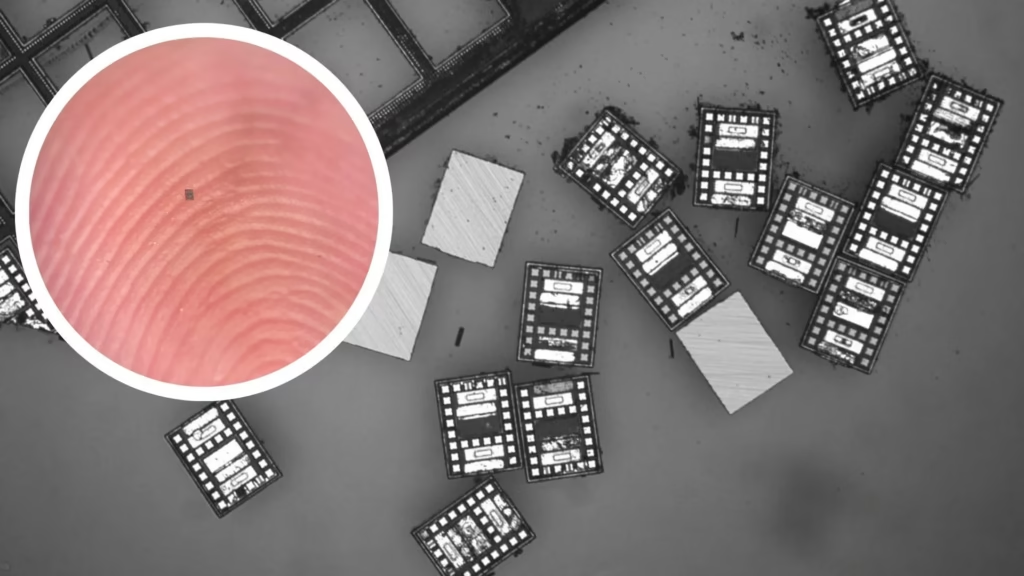
Microscopic machines at the scale of microorganisms
The programmable nanorobots developed by teams from Marc Miskin (University of Pennsylvania) and David Blaauw (University of Michigan) measure approximately 200 by 300 by 50 micrometers. To put this size in perspective, each robot is barely visible to the naked eye and exists at the scale of bacteria and single-celled organisms like paramecia.
This extreme miniaturization represents a major breakthrough in a field that has been stalled for four decades. Professor Miskin explains that these microscopic robots are “10,000 times smaller” than conventional autonomous robots, opening an entirely new scale for programmable robotics.
Despite their infinitesimal size, these autonomous nanorobots contain a miniaturized computer, temperature sensors, memory, a communication system, and a propulsion mechanism. All of this operates with just 75 nanowatts of power—approximately 100,000 times less than a smartwatch.
The most remarkable achievement? Each robot costs about one cent to manufacture and can operate for several months without interruption. This exceptional longevity is made possible by the complete absence of moving parts in their design.
A revolutionary propulsion system without moving parts
One of the major challenges in microscopic robotics lies in the unique physics that governs the world at this scale. At the millimeter scale, the physical laws that dominate our everyday experience, like gravity and inertia, give way to surface-related forces, such as drag and viscosity.
“If you’re small enough, pushing on water is like pushing through tar,” explains Marc Miskin. The propulsion strategies used by conventional robots, such as propellers or articulations, become completely ineffective at this scale.
The programmable nanorobots use an elegant solution: instead of pushing directly against water, they generate an electric field that displaces ions in the surrounding liquid. These ions then push neighboring water molecules, creating a flow that propels the robot forward. This electrokinetic propulsion system requires no moving parts, ensuring exceptional durability.
This approach allows robots to swim for months, be easily transferred using a micropipette, and even move in coordinated groups, similar to schools of fish. The speed achieved can reach one body length per second, which is remarkable at this scale.
A miniaturized brain powered by light
The intelligence of these autonomous nanorobots comes from ultra-miniaturized computers developed at the University of Michigan. These microscopic processors must operate with extremely low energy consumption, approximately 100,000 times less than a smartwatch.
“We had to completely rethink computer program instructions,” explains David Blaauw. The team condensed operations that would normally require multiple instructions into a single special instruction for propulsion control.
Most of the surface of each programmable robot is covered with solar cells that serve a dual function: they harvest light to generate energy and also serve as optical receivers. Light pulses are used both to power the robots and to program them.
Each nanorobot has a unique identifier that allows it to receive individualized instructions. This architecture enables researchers to send commands to the entire fleet or only to selected groups of robots, offering remarkable flexibility in their programming.
Ultra-precise temperature sensors
The current generation of programmable nanorobots is equipped with temperature sensors capable of detecting differences of one-third of a degree Celsius. This thermal sensitivity exceeds most digital thermometers of comparable volume.
The robots can move toward warmer areas or signal temperature changes by wiggling, a behavior compared to the “waggle dance” of bees. This capacity for thermotaxis (directed movement in response to a temperature gradient) mimics the behavior of many microorganisms.
In experiments conducted by the team, the microscopic robots continuously measure environmental temperature, convert readings into digital data, and transmit results to a base station by encoding information in their movements. When tested in a bath of solution that gradually warms up, their measurements perfectly match those of standard temperature probes.
At rest, nanorobots remain in place and spin in circles. But when they detect a temperature change, they automatically move toward warmer areas until the temperature stabilizes. A new series of light commands can reverse their trajectory, directing them toward cooler waters.
Promising future medical applications
The programmable nanorobots could radically transform several fields of medicine in the coming decade. Their microscopic size allows them to access areas of the human body inaccessible to conventional surgical instruments.
“I wouldn’t be surprised if in 10 years, we had real uses for this type of robot,” says David Blaauw. Envisioned applications include targeted drug delivery directly to diseased cells, monitoring the health of individual cells, repairing damaged tissues, and even early disease detection.
In the field of cancer, these microscopic medical robots could deliver chemotherapy agents directly to tumors, significantly reducing side effects on healthy cells. Recent research has already demonstrated that similar nanorobots can reduce bladder tumors by 90% in animal models.
The nanorobots could also monitor vital signs and collect patient health data in real time, enabling early detection and intervention in case of medical emergency. This capacity for cellular diagnosis could revolutionize preventive medicine.
Technical challenges and future perspectives
Despite these impressive advances, several obstacles must be overcome before programmable nanorobots can be used in the human body. Researchers must ensure that the materials used are biocompatible and do not cause unwanted immune reactions.
Marc Miskin emphasizes that the current microrobot is not yet ready for biomedical use but constitutes a general platform on which new features can be added. The current design works perfectly with electronics, circuits can be manufactured at large scale at low cost, and the architecture allows integration of new sensors.
Future versions could store more complex programs, move faster, integrate new sensors, or operate in more challenging environments. The team is also working on communication between microscopic robots for better coordination and on improving motors for faster and more agile movements.
“This is really just the first chapter,” concludes Miskin. “We’ve shown that you can put a brain, a sensor, and a motor into something nearly invisible and make it survive and function for months.”
A revolution at the microscopic scale
The programmable nanorobots developed by the University of Pennsylvania and University of Michigan represent a major technological breakthrough that solves a forty-year-old problem. By combining extreme miniaturization, programmable autonomy, and sustainable operation, these microscopic machines pave the way for revolutionary applications in medicine, manufacturing, and biological research.
With a manufacturing cost of one cent per unit and the ability to operate for months, these autonomous robots could be mass-produced and deployed for complex missions at the cellular scale. The study published in Science Robotics marks the beginning of a new era for microscopic robotics, where fleets of intelligent nanorobots could soon navigate through our bodies to monitor, diagnose, and treat diseases with unprecedented precision.
Source: Interesting Engineering – World’s smallest robots swim, sense heat, and think autonomously
“`